Forgiveness is tough and oftentimes messy, but we as humans continue to practice it. Why?
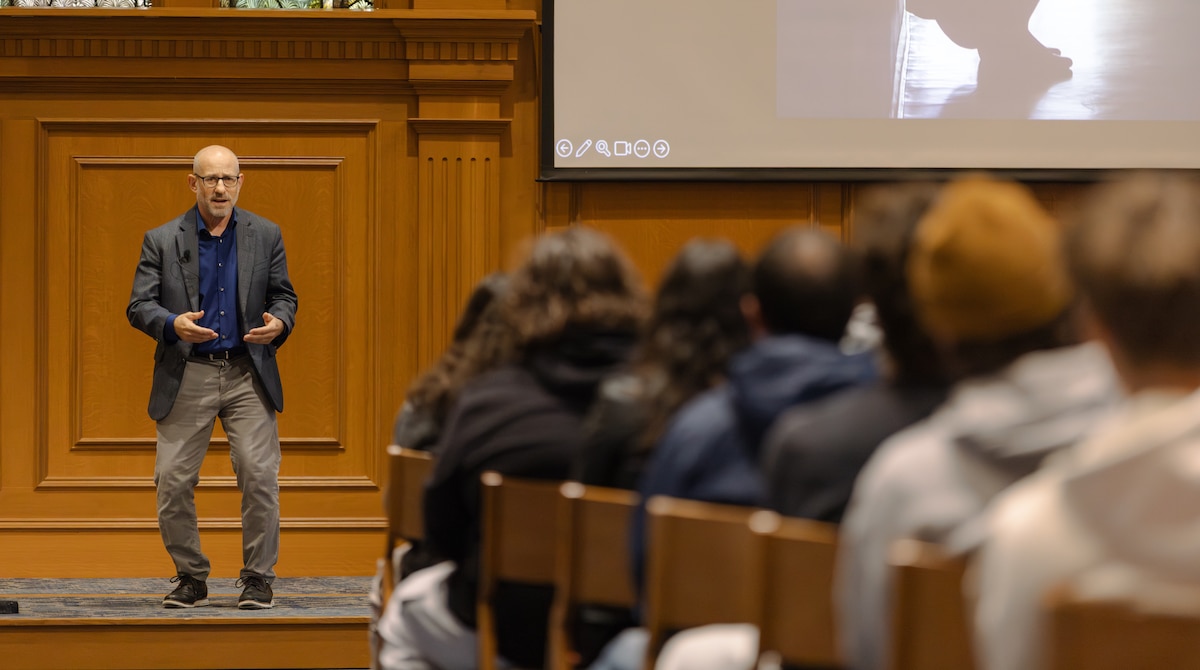
Professional counselor Rick Balkin has dedicated his life’s research on the topic. On Wednesday, Oct. 29, he presented a guest lecture, “What Does Forgiveness Mean – And Why Is It So Hard?,” as part of the Merrimack Academic Speaker Series.
Balkin serves as the chair of leadership and counselor education at the University of Mississippi. His book, “Practicing Forgiveness: A Path Toward Healing,” outlines his model for forgiveness to either repair relationships or move on when they are unsalvageable.
“(In 2003,) I went to join our new synagogue in Texas for Yom Kippur services,” he recalled. “Between morning and afternoon services, I stayed for the Torah study group. That is where I stumble on the Jewish conceptualization of forgiveness.”
There are three types of forgiveness in the Jewish faith, Balkin explained. “Kappara” is a form of spiritual forgiveness that only God can give while “Selicha” focuses on restitution. The third form, “Mechila,” is what Balkin bases his research around.
“Mechila means ‘to wipe away debt,’” he stated. “What I want from you I’m not going to get, so you don’t owe to me anymore. For some types of offenses, you can’t make restitution. Abuse, slander, neglect. What happens when we remove expectations from individuals?”
The first step to reconciliation, according to Balkin, is a collaborative exploration. The affected party needs to discuss and process the incident with a trusted person. Then, they need to decide if reconciliation is beneficial or not. If the person believes the relationship is worth salvaging and the perpetrator is able to show remorse or a change in behavior, the two parties can renegotiate the relationship. If the relationship is no longer beneficial, the affected party needs to process the unpaid debt, work through grief and, hopefully, reach Mechila.
As an example of Mechila, Balkin recalled his time studying in Rwanda after the 1994 genocide. The nation founded the National Unity and Reconciliation Commission in 1999 to mend relations between Hutus and Tutsis.
“A colleague of mine said, ‘If you really want to know about forgiveness, you need to visit Rwanda,’” Balkin recalled. “There, I met Maria…she said, ‘I am 70 years old and I am more beautiful than I’ve ever been.’ She found beauty in forgiveness.”