New federal school meal nutrition standards began this year and a Merrimack College professor and renowned expert on school nutrition policies will now examine the impact of those standards on school children.
Juliana Cohen, a professor in Merrimack’s School of Nursing and Health Sciences, received a five-year grant from the National Institutes of Health totaling more than $3 million, the single largest external independent research grant ever to be awarded to a Merrimack College faculty member.
The United States Department of Agriculture announced in April 2024 updates to the nutritional standards for school meal programs, which include both breakfast and lunch for more than 30 million children each day. The updates will be implemented over several years. Among the new standards are limits on added sugars in school meals and stronger sodium limits.
According to her grant proposal, Cohen said her study will evaluate the new policy’s impact on school meal compliance, school meal participation, student diet quality, dietary disparities and other key factors.
“We are looking at how the policy will change the food that is available, the impact on how much students are eating and how students are performing in school,” explained Cohen, who is also the director of the Center for Health Innovation, Research and Policy (CHIRP). “This is the first time ever someone is quantifying the amount of ultraprocessed food in school meals.”
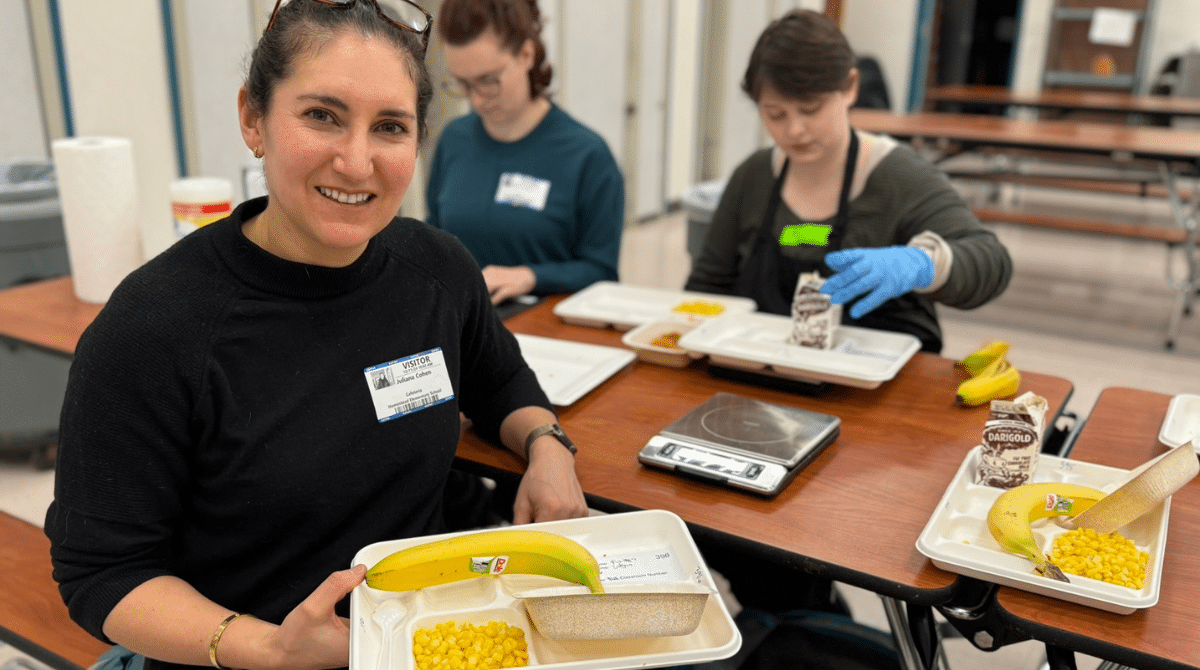
Cohen and her team have already established a significant baseline of data for this research, having collected more than 10,000 plate-waste measurements, sifting through leftover school meals in recent years. This data cataloging allows for a better understanding of how much students are eating and which foods they are consuming.
This past spring, her team traveled to Alaska, as part of another NIH R01 grant, where they conducted plate-waste measurements that were instrumental in building momentum for this study as they awaited notice of the grant. Merrimack College had previously provided funding to collect pilot data in Alaska, which enabled Cohen to receive the prior NIH grant and was a catalyst to receive this latest grant.
“I am incredibly grateful to the Merrimack College administration for its critical support of the work we did in Alaska,” Cohen said. “Because of strong collaborations across the U.S., such as the one that allowed us to work in Alaska, we are uniquely positioned to have the expertise and the proven track record to conduct this innovative study.”
By being on-site to examine school meals, Cohen said her team is also able to see what types of meals students bring from home.
“Most people think that home-packed school meals are so much healthier, but if you are looking at it from an ultraprocessed perspective, it is negligible,” Cohen explained. “On average, school meals are healthier than home-packed meals.”
As part of the research, Cohen will focus on school meals in Massachusetts, Connecticut, California and Arizona. There are also opportunities for Merrimack College students to support the research, from data collection to participating in the writing process.
Research reported in this publication was supported by the National Institute Of Diabetes and Digestive and Kidney Disease of the National Institutes of Health under Award Number: 1R01DK142702-01. The content is solely the responsibility of the authors and does not necessarily represent the official views of the National Institutes of Health.