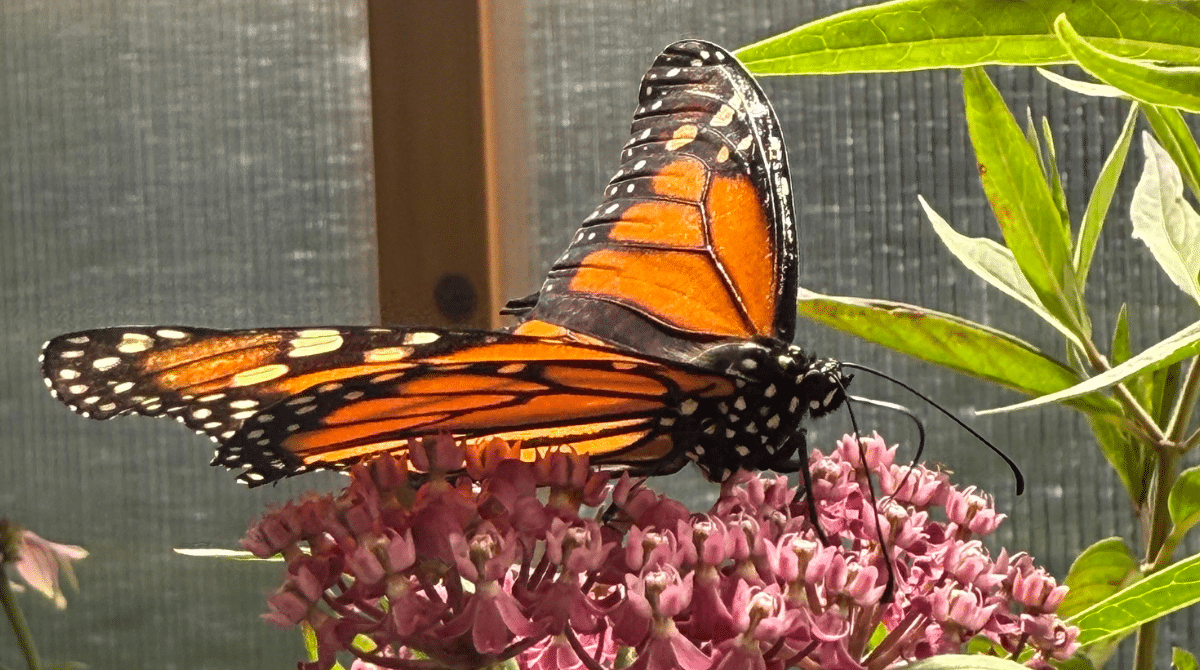
One of North America’s most migratory animals, the monarch butterfly, will soon have a new home on Merrimack College’s campus to migrate to in the spring.
The College’s Department of Environmental Sciences and Sustainability is working with Monarch Ranch, a Tewksbury-based organization, to develop a habitat to increase the monarch butterfly population. Monarchs are an incredibly at-risk species, largely due to habitat loss, pesticide usage and climate change.
”Merrimack College has now dedicated parts of on-campus space towards the development of local biodiversity conservation,” explained Kristy McDowell, chair of the Department of Environmental Sciences and Sustainability, who is spearheading this effort. “The work Merrimack College is doing in collaboration with Monarch Ranch is helping to create and support habitat that is critical for monarch survival long-term and our intention is for this project to be a long-term initiative at Merrimack.”
Beginning in fall 2025, students and faculty have tended grounds around campus, including along Rockridge Road and next to Martone-Mejail Field, built raised garden beds and planted milkweeds for butterflies to feed off of. In June, there will be a butterfly hatching and release on campus.
Raynna Collier ’27, environmental sciences and sustainability and biology double major, interned with Monarch Ranch over the summer and continued working on conservation efforts at Merrimack this academic year. She is among 80 Merrimack students working on the project this academic year. She noted that what drew her to the project was doing research and science in a unique setting.
“I already had one internship where I worked in a lab doing data recording, which I enjoyed, but wanted to expand my horizons and get a different taste of different fields,” Collier said. “After this experience, I definitely appreciated the work that goes into this kind of conservation project a lot more. It helped me determine that I’m more interested in field research now, and being outside collecting firsthand data.”

Monarchs can travel up to 100 miles per day in their migration to warmer climates like Mexico and California during the winter. Newer generations of monarchs that follow the “parent” butterflies during migration eventually find their way back home in the spring, as this pathway is written into their genetics.
According to the National Wildlife Federation, as of January 2025, there has been a 96 percent decline in the population of monarchs compared to last year’s migration in California. These migratory butterflies serve as pollinators and assist in the survival and growth of various ecosystems.
McDowell shared why this project is so important both to our students and our environment:
“This project offers our environmental science students valuable hands-on field experience while enhancing Merrimack’s biodiversity and strengthening partnerships within the local community,” said McDowell. “By aligning with nearby pollinator habitats in the surrounding towns, this initiative fosters greater participation and deeper community connections. Its impact will be wide-ranging, benefiting both students and the ecosystems they support.”
A pollinator festival is scheduled for April 10 starting at the O’Brien Plaza then moving to the Merrimack College Garden on Rockridge Road. More details will be available soon.