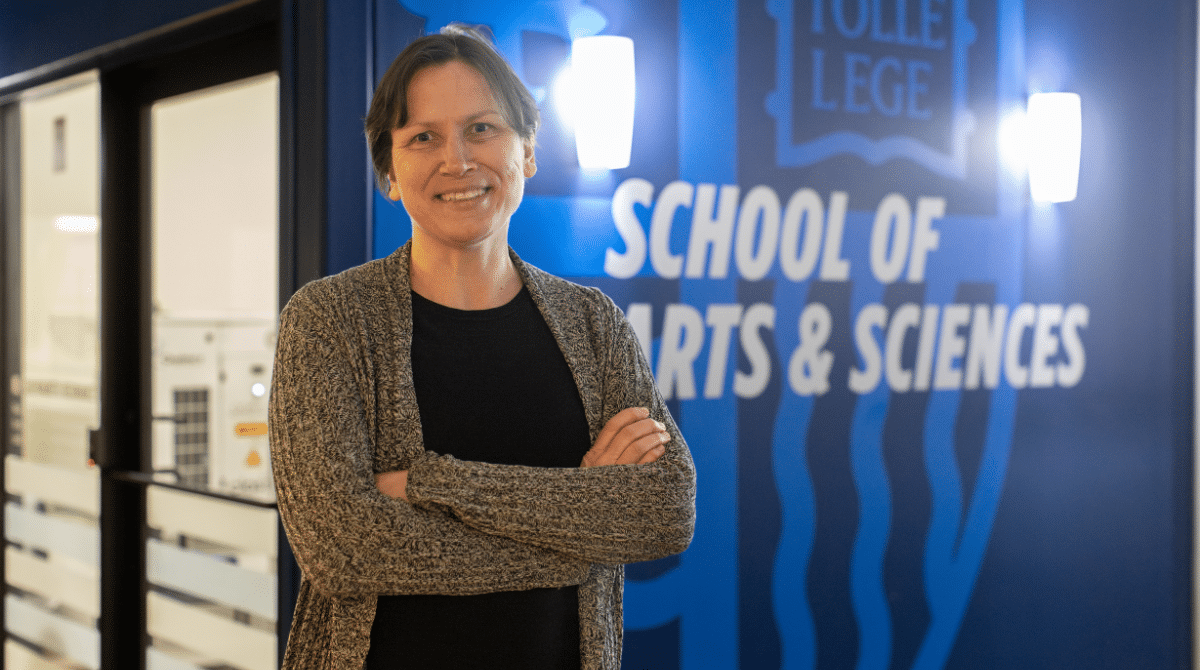
To make society-changing health discoveries, renowned biologist and researcher Christine Vogel focuses on the molecular level. And she is bringing that scholarship, with the potential for huge, transformative impacts, to Merrimack College.
Currently a professor at New York University, Vogel and her team seek to better understand how those cells, and the proteins in cells, react to stress from environmental pressures. Their findings will inform solutions to address mutations or suppressions caused by that stress, particularly in neurodegenerative diseases.
“We look at gene expression regulation in the context of neurodegenerative diseases, with a focus on protein expression and how genes may be affected,” Vogel explained. “And that is what we are bringing to Merrimack College.”
Vogel’s excitement about Merrimack grew after learning more about the College’s growing research infrastructure, both in the lab and in the classroom. Through infrastructure investments, including new lab space in Palmisano Hall, Vogel saw the resources needed to enhance her groundbreaking work. In the College’s continued pursuit of an R2 classification, Vogel saw an opportunity to also bring her years-long experience in leading a Ph.D. program.
“I was looking for a place where I could do science and help make the world a better place and Merrimack felt exactly like that,” Vogel said. “And establishing a new Ph.D. program is an amazing opportunity.”
When she officially starts at Merrimack in the School of Arts and Sciences, she will do so as the first such endowed chair at Merrimack College. A key tool in faculty recruitment and retention, an endowed chair is a distinguished honor that recognizes an outstanding faculty member’s work of scholarship and guarantees continued support to make a lasting impact among students and in their fields of study.
Merrimack College Trustee Bruce Bouchard ’79 and Sandra Bouchard are leading the way in growing Merrimack’s portfolio of endowed positions with the establishment of the Bruce A. ’79 and Sandra Bouchard Endowed Chair in Life Sciences, as part of the Together We Rise capital campaign.
“Sandy and I have long believed in the power of life sciences research to improve people’s lives,” said Bouchard. “When I sat down with Vice President of Research April Bowling and realized how transformational an endowed chair is in attracting and retaining top faculty research talent, I knew this was the right place for our gift to go.”
Vogel noted the Bouchards’ generosity represents an important step forward in Merrimack’s research trajectory.
“I am truly honored to be joining Merrimack as the inaugural Bruce A. ’79 and Sandra Bouchard Endowed Chair in Life Sciences and to play a part in Merrimack’s journey,” Vogel said. The Bouchards’ support of the life sciences and the College’s commitment to innovative and life-saving research will bring Merrimack that much closer to R2 classification.”
As her research has evolved, Vogel and her team have focused on the impact of stress on specific genes, particularly C9ORF72, which regulates the breakdown of old or damaged proteins and vesicular trafficking at multiple levels. It is also the gene that, when mutated, is one of the most frequent genetic causes of Amyotrophic Lateral Sclerosis (ALS), also known as Lou Gehrig’s disease.
“C9ORF72 is an important gene of the cell and everybody in the field has been studying the mutations that lead to ALS,” she said. “My point is we also need to understand how this gene is functioning under normal conditions.”
Building on her findings, the lab is now working on a new therapeutic avenue that uses RNA editing to reverse one of the detrimental effects of the C9ORF72 mutation.
“We filed a provisional patent for this therapy in August and the first results look very promising,” she explained. “In the healthy neuron, the cell actually produces very little C9ORF72 through a complicated repressor mechanism. Now, when you have the ALS mutation, one effect is that you produce even less C9ORF72. Our aha moment was when we realized – ‘Why don’t we try and develop a drug that represses the repressor and thus gets C9ORF72 levels back up in the ALS case?’”