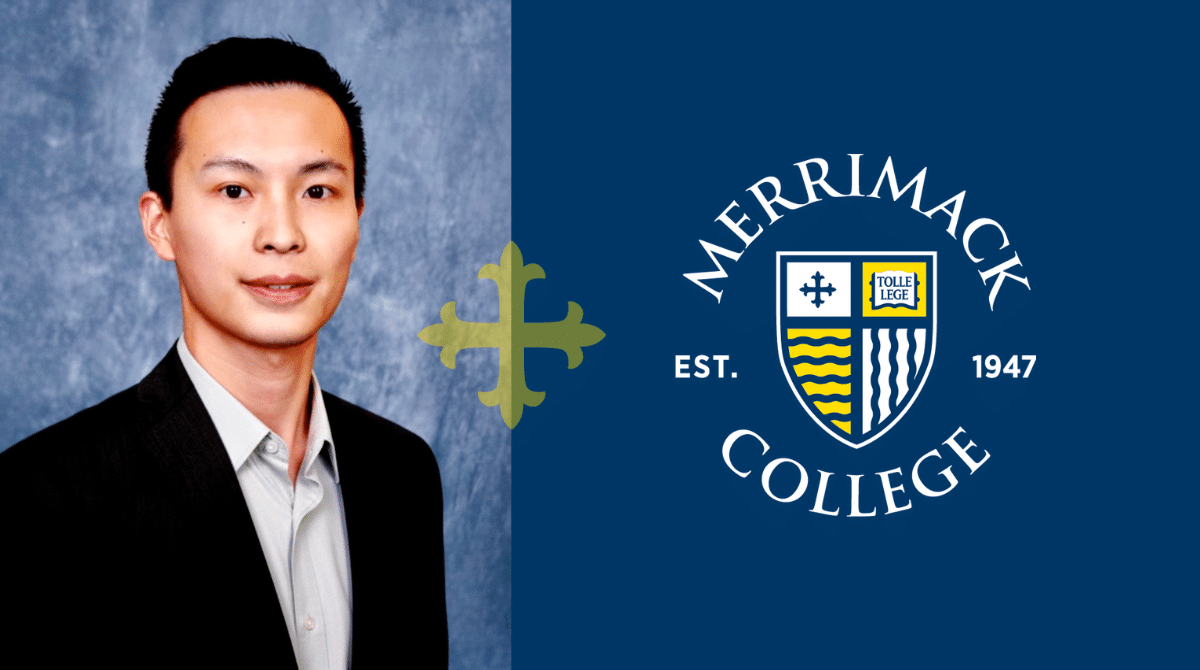
What started as a fun pandemic project might soon evolve into a newly published academic research study by Merrimack College Associate Professor of Marketing Eric Zheng.
Over the past four years, Zheng has digitally labeled and trained nearly 10,000 wine labels and, using a machine learning algorithm he personally programmed, he hopes to find the science behind the perfect label.
“At liquor stores, there are hundreds of wines,” Zheng explained. “I wanted to see if there’s any systematic way to study them at a larger scale to find some common characteristics. Eventually, I want to use the findings I have and help advise future label design. It could help marketers and label designers find the key factors they need to include in order to sell their wine more efficiently.”
Zheng will demonstrate his algorithm at the McQuade Library’s annual Tolle Lege celebration as the Girard School of Business faculty presenter. The Tolle Lege collection catalogs published works by Merrimack College students, faculty and staff, and the McQuade Library holds an annual event to recognize its newest additions. In 2025, 108 Warriors published 204 pieces.
“The algorithm will pick up many aspects from the label and give it a classification in real time,” he explained. “I’m very comfortable talking with colleagues about my research. It feels like I’m at home just chatting.”
Zheng’s study is a perfect blend of his two passions: digital marketing and wine. His previous research dealt with how to best optimize pitches on crowdfunding websites to secure more funding.
“I’m an intro wine sommelier certified by the Court of Master Sommeliers,” he explained. “I like studying wine labels because it’s like studying art. Every label is so different and it is unpredictable. I like the challenge of finding the similarities.”
Each label Zheng scans into his algorithm is categorized by name, marker, vintage, appellation and what types of graphics and images it may have.
“It’s more quantitative versus visually examining one by one, which is more qualitative,” he explained.
Originally, Zheng planned to partner with a graphic designer to further test his hypotheses. But then the world was introduced to AI.
“That presented another interesting aspect,” he said. “These days, AI is so good at designing graphs and images. Once we start identifying key things, can we ask AI to generate labels for us and test how effective it is versus human creation?”
Zheng also has more ideas for his study, such as tracking eye movements from volunteers to see which parts of the label they notice first.
“How much does the label really influence people’s decision to pick up and buy a wine bottle?,” he asked. “When you can’t taste it, every single bottle seems to be the same. You can only judge it from your imagination.”
While Zheng hopes to gather more data before officially submitting his study to a scientific journal, he already has plans for another project.
“One of my most recent research projects that I proposed with my GSB colleagues is to look at how we discover students’ AI capacity and aptitude,” he explained. “For example, when we put them into scenarios where they need to solve real-world problems, how well can they accomplish it using AI tools? How do they approach these tools? How do they like working with them or not? How does it impact their output quality?”