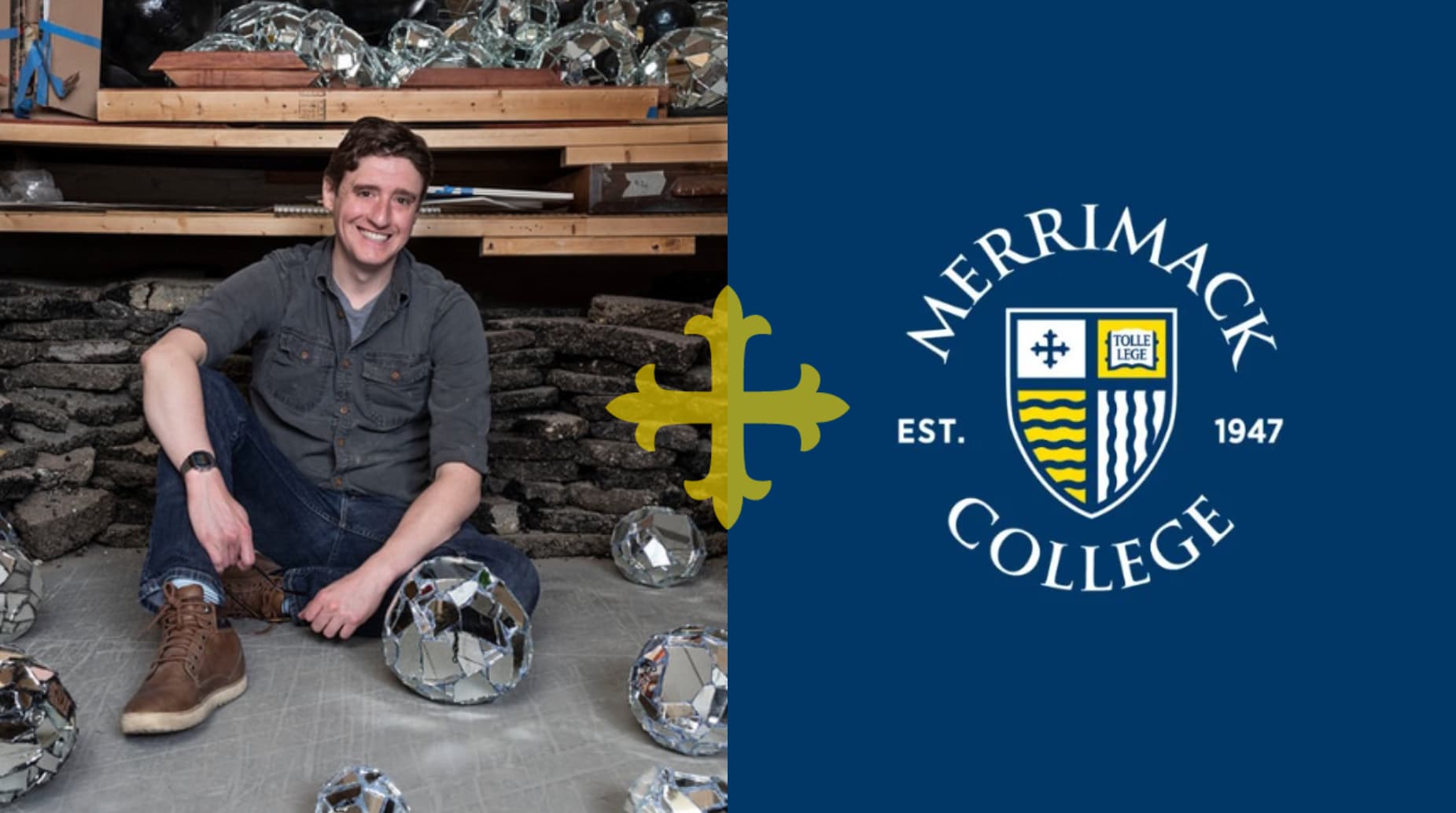
Jonathan Latiano didn’t just build a sandcastle; he turned one into a monument to time, labor, and the magic of scale. Scaling a Pyramid, his latest artistic installation, opened at the Boston Sculptors Gallery in the SoWA Art and Design District earlier this year, as well as just closed at Chimera Gallery in Philadelphia, PA. On the surface, it’s a tiny sand pyramid on a pedestal. But once you step inside the gallery, the weight of the work hits you.
Every grain of sand in that pyramid—2,238 to be exact—has been photographed individually. Each image, enlarged and displayed in a clean grid across the gallery walls, surrounds the small sculpture. The contrast between the tiny object and the massive visuals forces you to reconsider what scale even means.
The work began over a decade ago, when Latiano scooped up a handful of coral sand from a beach in Runaway Bay, Jamaica. He shares, “Not knowing anything about coral sand at the time, I could still tell just by looking that there was something really special about the material.” He brought it back in a Coca-Cola bottle, where it sat in his studio for almost ten years.
Sometimes, an idea takes that long to settle.
When it finally did, Latiano dove right in. Photographing each grain was the central act of the project. With help from Merrimack College’s Biology Department, and the late photographer Kevin Salemme, Latiano learned to capture sand at a cellular level. It took months of experimentation, a specialized camera, a high-powered microscope, imaging software, ingenuity, and persistence. Remembering the process, he states, “The moment we first captured an image in print-quality detail—I knew this project was actually going to work.”
However, finishing it was another challenge altogether. “About a year in, there was still no clear light at the end of the tunnel, and it was easy to lose the initial excitement that had propelled me at the beginning,” Latiano explains. “I worked hard to build a solid routine and made sure I had other creative projects running in parallel. Stepping away occasionally to give my eyes and brain space to decompress was crucial. And just as importantly — a steady supply of good audiobooks and podcasts helped keep me grounded and motivated through the more monotonous stretches.”
At the core of Scaling a Pyramid is a simple but loaded gesture: reducing the Great Pyramid of Giza, a structure symbolic of permanence, to a fragile sandcastle. It’s an exact 1:5,761 scale model, housed in a vitrine container, placed on a tiered pedestal. In Latiano’s words, the pyramid isn’t just an object; it’s an action. A meditation on accumulation, endurance, and impermanence.
What looks like a playful reference to childhood beach memories unfolds into something much deeper. The grains themselves are ancient; some biological, others geological, worn by erosion into intricate micro-objects. Looking at them through the microscope, Latiano began to see individual personalities, giving them nicknames. They’re time itself, shattered and reassembled.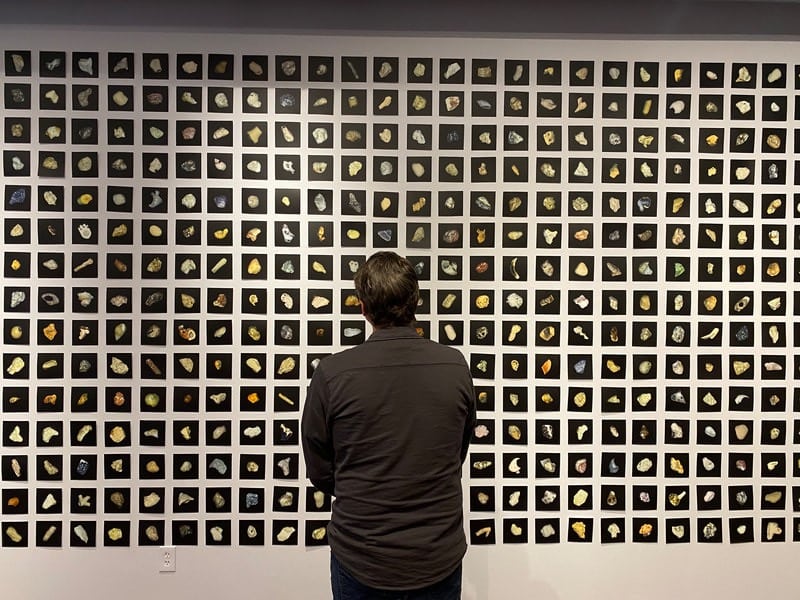
As artist Angela McQuillan wrote in the book that accompanies the show, “By uniting the ancient and the transient, [Latiano] redefines not just our understanding of scale but also our perception of time, permanence, and the forces that shape the world around us.” The project sits at the intersection of art and science, illustrating and revealing natural processes from angles we would never think to look at.
The response from the Boston show was strong. “It was wonderful,” Latiano reflected. I was thrilled with the feedback I received on the installation, and in the end, I felt really good about the project. Openings like this are always a little stressful, especially for a project of this scale, because I never see the work fully installed until just a day or two before the show opens. But once everything came together and I saw how people were engaging with the piece, it was incredibly rewarding.”
More information, including images and a video walkthrough, is available at jonathanlatiano.com/scaling-a-pyramid and chimaeragallery.com.